NASA-UAP-D4, Apollo 11 Technical Crew Debriefing, 1969
NASA-UAP-D4, Apollo 11 Technical Crew Debriefing, 1969
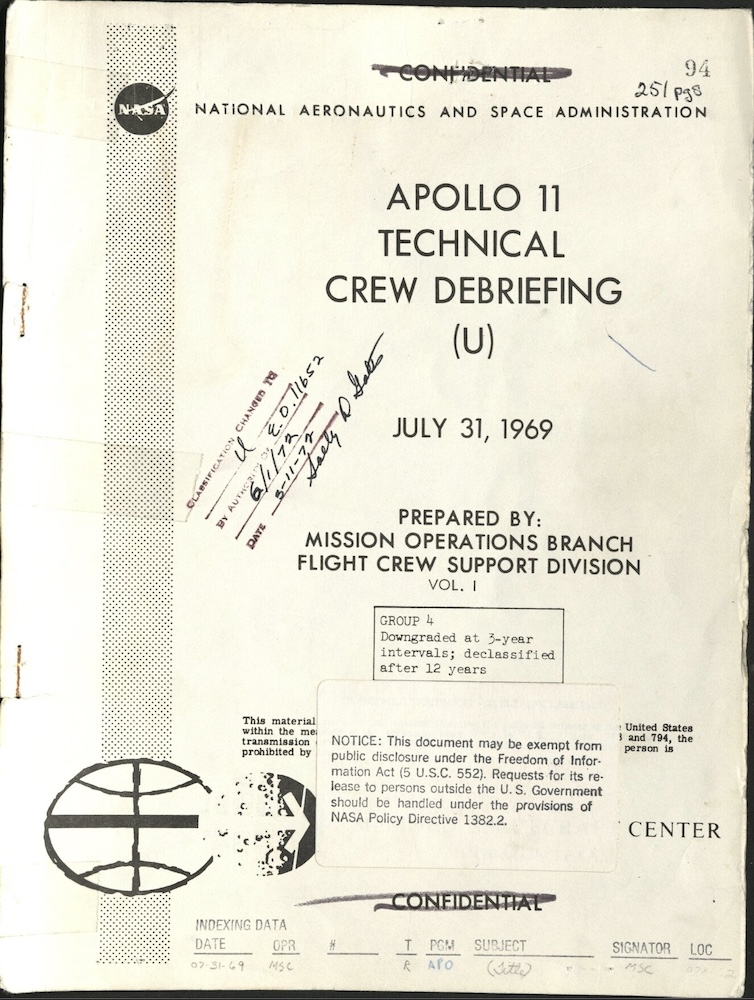
Apollo 11 was the third crewed mission to the Moon and the first to land Astronauts on the lunar surface. This document is an excerpt from the Apollo 11 Technical Crew Debriefing (Volumes 1 and 2) from July 31, 1969. The document highlights three observations: one, an object on the way out to the Moon; two, flashes of light inside the cabin; and three, a sighting on the return trip of a bright light tentatively assumed by the crew to be a laser. • Page 6-33 (Vol. 1). [Lunar Module Pilot for Apollo 11, Buzz Aldrin]: “The first unusual thing that we saw I guess was 1 day out or something pretty close to the moon. It had a sizeable dimension to it, so we put the monocular on it.” The crew speculated that it could have been the S-IVB stage of the Saturn V launch vehicle. • Page 6-37 (Vol. 1). [Lunar Module Pilot for Apollo 11, Buzz Aldrin] “The other observation that I made accumulated gradually. I don’t know whether I saw it the first night, but I’m sure I saw it the second night. I was trying to go to sleep with all the lights out. I observed what I thought were little flashes inside the cabin, spaced a couple of minutes apart…” • Page 21-1 (Vol. 2). [Lunar Module Pilot for Apollo 11, Buzz Aldrin] “I observed what appeared to be a fairly bright light source which we tentatively ascribed to a possible laser.”
Download
Metadata
Extracted Text
show full text
--- page 1 ---

§5§ NATIONAL AERONAUTICS AND SPACE ADMINISTRATION |
S 2
e F LY
aiam S JULY 31, 1969
. B
. mwp PREPARED BY:
S d  MISSION OPERATIONS BRANCH
s FLIGHT CREW SUPPORT DIVISION
nmmn VOL. | .
GROUP 4 )
S Downgraded at 3-year
intervals; declassified ‘
This material rUnltedDBtazes
RO Kfl?mifl'im”‘n’: NOTICE: This document may be exempt from ’p:‘;:;; :L e
Ssnlnnnn prohibited by | public disclosure under the Freedom of Infor-
. it mation Act (5 U.S.C. 552). Requests for its re-
- 'rg;z' lease to persons outside the U. S, Government
Sesae should be handled under the provisions of
i NASA Policy Directive 1382.2. L GCE NTE R
L e 9:, >
L-—*


--- page 2 ---

: MWTGNE!QENI% 6-33

COLLINS I think particularly when you get into the later flights
of extended EVA's and lunar activity, somehow the crew
must place themselves in a frame of mind of looking on
the separation of the IM as the beginning of the flight
plan and to relax, get plenty of sleep, and conserve

’ their energies in all the events leading up to that

3 point. To arrive in lunar orbit tired can create prob-
lems and it's possible to do that if you don't approach
it in the right frame of mind.

ARMSTRONG I think Mike's hit the nail on the head. We did precisely
that. We got a lot of rest and got into lunar orbit eager
to go to work and that's a particularly fortunate position
to be in.

COLLINS This is something we've talked about before the flight
and I don't know how you can get yourself in that frame

4 of mind but I think it is a frame of mind. You have to
get yourself convinced that there will be a nice relaxing
3 couple of days going to the moon.

ALDRIN The first unusual thing that we saw I guess was 1 day out
or something pretty close to the moon. It had a sizeable
dimension to it, so we put the monocular on it.


--- page 3 ---

T ww@NfiBW
COLLINS How'd we see this thing? Did we just look out the window
and there it was? ?
ALDRIN Yes, and we weren't sure but what it might be the S-IVB.
We called the ground and were told the S-IVB was 6000 miles
away. We had a problem with the high gain about this c
time, didn't we?
COLLINS There was something. We felt a bump or maybe I just
imagined it.
ARMSTRONG He was wondering whether the MESA had come off.
COLLINS I don't guess we felt anything.
ALDRIN Of course, we were seeing all sorts of little objects Y
going by at the various dumps and then we happened to see
this one brighter object going by. We couldn't think of
anything else it could be other than the S-IVB. We looked
at it through the monocular and it seemed to have a bit
of an L shape to it. -
ARMSTRONG Like an open suitcase.
ALDRIN We were in PTC at the time so each one of us had a chance
to teke a look at this and it certainly seemed to be with-
in our vicinity and of a very sizeable dimension. )
B T T T O SR AT 5, TP O SR 57 6. o, P e 0 U ORL L LR E R U AR o1 - SRS 0 LR || U e i LR LS RS R R e R


--- page 4 ---

- CORMDENFTAT &%
ARMSTRONG We should say that it was right at the limit of the reso-
lution of the eye. It was very difficult to tell just
what shape it was. And there was no way to tell the size
without knowing the range or the range without knowing
the size.
ALDRIN So then I got down in the LEB and started looking for it
3 in the optics. We were grossly mislead because with the
sextant off focus what we saw appeared to be a cylinder.
ARMSTRONG Or really two rings.
ALDRIN Yes.
ARMSTRONG Two rings. Two connected rings.
COLLINS No, it looked like a hollow cylinder to me. It didn't
look like two connected rings. You could see this thing
; tumbling and, when it came around end-on, you could look
2 right down in its guts. It was a hollow cylinder. But
then you could change the focus on the sextant and it
would be replaced by this open-book shape. It was really
weird.
ATDRIN I guess there's not too much more to say about it other
than it wasn't a cylinder.
|


--- page 5 ---

COLLINS It was during the period when we thought it was a cylinder
that we inquired about the S-IVB and we'd almost convinced
ourselves that's what it had to be. But we don't have
any more conclusions than that really. The fact that we
didn't see it much past this one time period — we really
don't have a conclusion as to what it might have been, ;
how big it was, or how far away it was. It was something 4
that wasn't part of the urine dump, we're pretty sure of
that.
Skipping ahead a bit, when we jettisoned the IM, you know
we fired an explosive charge and got rid of the docking
rings a.fid the IM went boom. Pieces came off the IM. It
could have been some Mylar or something that had somehow
come loose from the IM.
ALDRIN We thought it could have been a panel, but it didn't |
appear to have that shape at all. k:
COLLINS That's right, and for some reason, we thought it might 7
have been a part of the high gain antenna. It might have
been about the time we had high gain antenna problems.
In the back of my mind, I have some reason to suspect that
its origin was from the spacecraft.
| CONFIDENTIAE |


--- page 6 ---

“CONEIDERFt— o
ATLDRIN The other observation that I made accumulated gradually.

5 I don't know whether I saw it the first night, but I'm
sure I saw it the second night. I was trying to go to
sleep with all the lights out. I observed what I thought
were little flashes inside the cabin, spaced a couple of

! minutes apart and I didn't think too much about it other

5 than just note in my mind that they cont::Lnued to be there.
I couldn't explain why my eye would see these flashes.
-Du.ring transearth coast, we had more time and I devoted
more opportunity to investigating what this could have
been. It was at that point that I was able to observe
on two different occasions that, instead of observing
just one flash, I could see double flashes, at points
separated by maybe a foot. At other times, I could see
a line with no direction of motion and the only thing
that comes to my mind is that this is some sort of pene-

« tration. At least that's my guess, without much to sup-
port it; some penetration of some object into the

- spacecraft that causes an emission as it enters the cabin
itself. Sometimes it was one flash on entering. Possibly
departing from an entirely different part of the cabin,
outside the field of view. The double flashes appeared
to have an entry and then impact on something such as
the struts. For a while, I thought it might have been ; '

/W


--- page 7 ---

I R B AR . 7 A s o e e e e e
i CEONFDENT
ATLDRIN some static electricity because I was also able, in moving
(coNT'D)
my hand up and down the sleep restraint, to generate
very small sparks of static electricity. But there was
a definite difference between the two as I observed it
more and more. I tried to correlate this with the direc—
tion of the sun. When you put the window shades up there :
is still a small amount of leakage. You can generally i
tell within 20 or 30 degrees the direction of the sun.
It seemed as though they were coming from that general
direction; however, I really couldn't say if there was
near enough evidence to support that these things were
observable on the side of the spacecraft where the sun
was. A little bit of evidence seemed to support this.
I asked the others if they had seen any of these and,
until about the last day, they hadn't.
ARMSTRONG Buzz, I'd seen some light, but I Just always attributed
this to sunlight, because the window covers leak a little %
bit of light no matter how tightly secured. The only
time I observed it was the last night when we really
looked for it. I spent probably an hour carefully watch-
ing the inside of the spacecraft and I probably made
50 significant observations in this period.


--- page 8 ---

R R R R R R RRRRRREEEEE——j}j}W™a
CONEIDERTIAT s
ALDRIN Sometimes a minute or two would go by and then you'd see
the two within the space of 10 seconds. On an average,
I'd say just as a guess it was maybe something like one
a minute. Certainly more than enough to convince you
that it wasn't an optical illusion. It did give you a |
3 rather funny feeling to contemplate that something was
& zapping through the cabin. There wasn't anything you
could do about it.
ARMSTRONG It could be something like Buzz suggested. Mainly a
neutron or some kind of an atomic particle that would
be in the visible spectrum.


--- page 9 ---

Ay
NATIONAL AERONAUTICS AND SPACE ADMINISTRATION
e o8 J);(U)
A ¢ % “‘5:’ ")
BN ¢
R o
S\ PREPARED BY:
R MISSION OPERATIONS BRANCH
S FLIGHT CREW SUPPORT DIVISION
S Downgraded at 3-year
2-5555535153335351535355 intervals; declassified
PR after 12 years
] e material ¢ NOTICE: This document may be exempt from s
s transmission or  public disclosure under the Freedom of Infor- werson is
s prohibited by 14 mation Act (5 U.S.C. 552). Requests for its re-
2R lease to persons outside the U.S. Government
roe @b should be hancled under the provisions of
oo g NASA Pclicy Directive 1382.2.
e CENTER
b ok


--- page 10 ---

——— s
21.0 VISUAL SIGHTINGS

ARMSTRONG Most of the items in Section 21, Visual Sightings, have

been previously reported. -
21.4 TRANSLUNAR AND TRANSEARTH FLIGHT

ALDRIN There was only one minor observation returning from the
Moon. Looking back at it, at a time after Mars had passed
behind the Moon, there was one time period where I imagined
that the image of Mars was coming from a region where it
couldn't come from, because it was in a dark portion of
the Moon. This obviously was an optical illusion of some
sort.

ARMSTRONG I suspect that it was, in fact, just immediately adjacent
to the horizon.

AIDRIN We must have looked at it immediately after it had come

. from the back side.

; ARMSTRONG Yes.
o 21.5 LUNAR ORBIT

AIDRIN In lunar orbit, following ascent, we did note and mention
to the ground that approaching CDH when the Earth came up
above the lunar horizon, I observed what appeared to be a 5
fairly bright light source which we tentatively ascribed :


--- page 11 ---

ALDRIN to a possible laser. That seemed to be the best possible
(coNT'D) |
explanation until we were coming back in the command module
approaching the Earth and were able to observe something
that gave about the same appearance. When putting the &
monocular on the light source, it appeared as though it
was the reflection of the Sun from a relatively smooth body 7
of water such as a lake. I think we've revised our initial
conclusion as to what the source of that light was that we
saw coming from the Earth. If no one owns up to having
beaxi\ed the laser toward the Moon at that time, it was more
probably a reflection off a lake. I still think it's an
unusual phenomenon, at that distance, to see so bright a
source of light. In the film, it didn't appear as though
this was going to show up at all. The Earth was too bright. y