NASA-UAP-D7, Skylab Techincal Crew Debriefing 1973
NASA-UAP-D7, Skylab Techincal Crew Debriefing 1973
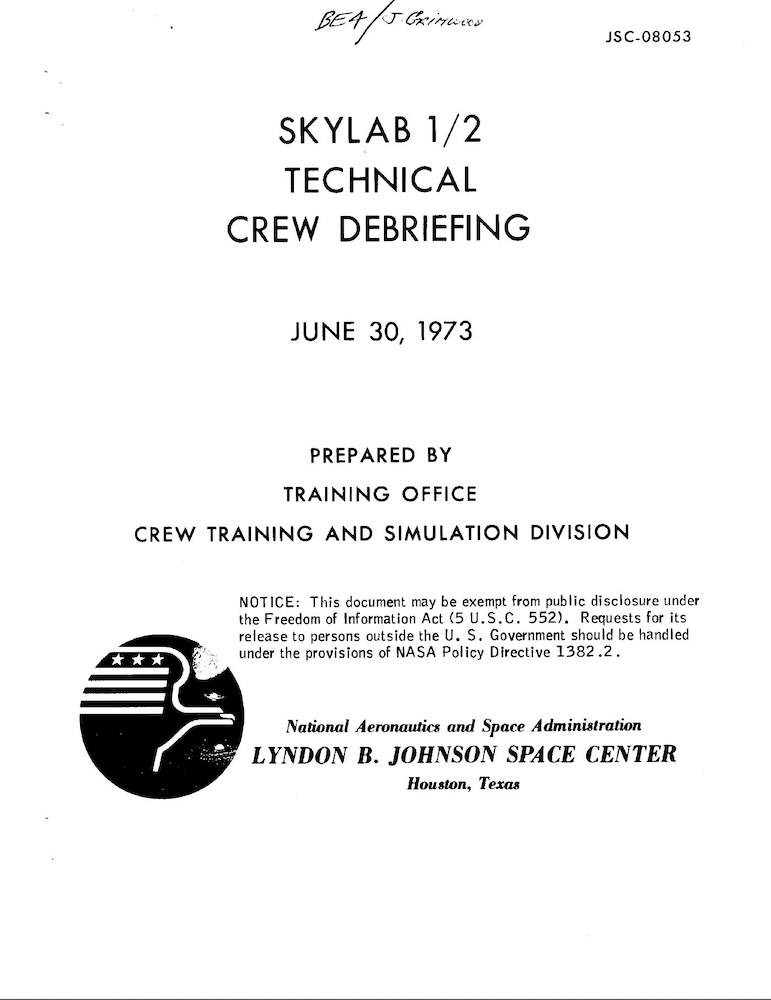
Launched on May 14, 1973, Skylab was the United States’ first laboratory in space. From 1973 to 1974, the station was visited by three crews. This document contains excerpts from all three crews to visit the station. In the first excerpt taken from Skylab 1/2 [first crew] Technical Debriefing from June 30, 1973, highlights crew observations of light flashes. The second excerpt taken from Skylab 1/3 Technical Crew Debriefing from October 4, 1973, highlights two observations—a satellite in similar orbit and another object with a “reddish hue to it.” The final excerpt taken from the Skylab 1/4 Technical Crew Debriefing from February 22, 1974, highlights an observation of flashing lights outside Skylab. • Skylab 2 crew observation: o Page 23-20. [Science Pilot for Skylab 2, Joesph Kerwin] “We saw light flashes. I think all of us saw them. I saw them most often when I was in the sack at night with my eyes closed but awake naturally. They tended to wax and wane in frequency.” • Skylab 3 crew observations: o Page 7-4. [Science Pilot for Skylab 3, Owen Garriott] “We saw that satellite about a week before splashdown. That was one of the most unusual things that we saw and I guess Jack [Lousma] noticed it looking out the window. This bright reddish object was out there and we tracked it for about 5 or 10 minutes. It was obviously a satellite in a very similar orbit to our own.” o Page 20-1. [Science Pilot for Skylab 3, Owen Garriott] “Jack [Lousma] first noticed this rather large red star out the wardroom window. Upon close examination, it was much brighter than Jupiter or any of the other planets. It had a reddish hue to it, even though it was well above the horizon.” • Skylab 4 crew observation o Page 7-8. [Commander for Skylab 4, Gerald P. Carr] “One other area of unusual events that we reported on the dump tapes was that on occasion we saw some lights flashing outside with very a definite motion relative to ours. We presumed that they were other pieces of Skylab, or possibly other satellites.”
Download
Metadata
Extracted Text
show full text
--- page 1 ---

JSC-08053
TECHNICAL
JUNE 30, 1973
PREPARED BY
TRAINING OFFICE
CREW TRAINING AND SIMULATION DIVISION
NOTICE: This document may be exempt from public disclosure under
the Freedom of Information Act (5 U.S.C. 552). Requests for its
release to persons outside the U. S. Government should be handled
’ under the provisions of NASA Policy Directive 1382.2.
National Aeronautics and Space Administration
LYNDON B. JOHNSON SPACE CENTER
Houston, Texas


--- page 2 ---

KERWIN Unusual or Unexpected Visual Phenomenon. We saw light flashes.

(CoNT'D)
I think all of us saw them. I saw them most often when I was
in the sack at night with my eyes closed but awake naturally.
They tended to wax and wane in frequency. Someone asked me if
that was in conjunction with the South Atlantic anomaly. It
may have been. I didn't have the pad with me at that time and
I don't know. They were numerous at times - two or three per
minute.

CONRAD Some of them to me were a spot or sunbursts. Some were streaks.
The streaks, in my case, were less frequent than the bursts.
Most of them were in my peripheral visual field. Very few in
the central visual field. I don't know why.

QUERY You could isolate them to one eye, couldn't you? .

KERWIN No, I couldn't.

WEITZ I would say mine were primarily in the left eye for some
reason.

CONRAD You have to concentrate but you can determine they are in one
eye.

SERWIN I did not. That was foolish of me but I didn't try. I'm sure
they are in one eye.

23-20


--- page 3 ---

CONRAD Sometimes I'd be lying there with my eyes half closed, and I'd
see a fire sensor wink.

KERWIN And you'd have to be careful that you weren't confusing that
with the fire flash. Once you've seen a few of each, there is
question of which is which. They're not an hallucination.

KERWIN We didn't feel it was operationally necessary for anybody to
know about it right now.

WEITZ I had a couple that I thought were cosmic particles. I saw
an entrance streak and an exit streak.

CONRAD Yes, I did too.

WEITZ Where, bing-bing, it seemed like it was one side of the eyeball,
and then the other side.

CONRAD One night I remember that there was a long shot then it was
blank then there was a long shot in rapid succession, of
course, but very definitely in and out - or across the eye.

KERWIN Medical Kits and IMSS. As far as adequate quantity of medica-
tion and supplies, I would guess we used about 0.0l percent
of the available medication. I think this is something for )
me to sit down with the doctors and talk about. There is
plenty of medicine up there for the Skylab missons. There is

23-21


--- page 4 ---

JSC-08478
TECHNICAL
| CREW DEBRIEFING |
PREPARED BY
TRAINING OFFICE
CREW TRAINING AND SIMULATION DIVISION
NOTICE: This document may be exempt from public disclosure
under the Freedom of Information Act (5 U.S.C. 552). Requests
for its release to persons outside the U.S. Government should be
handled under the provisions of NASA Policy Directive 1382.2.
. -
o ' ) ‘ National Aeronautics and Space Administration
, ’ = LYNDON B. JOHNSON SPACE CENTER
B Houston, Texas
OCTOBER 4, 1973


--- page 5 ---

BEAN I did too. Thev sack would move over in the corner.

LOUSMA Things we saw out the window.

GARRIOTT For example, we saw that satellite about a week before splash-
down. That was one of the most unusual things that we saw
and I guess Jack noticed it looking out the window. This
bright reddish object was out there and we tracked it for
about 5 or 10 minutes. It was obviously a satellite in a very
similar orbit to cur own. Tt was rotating and had a period
of almost exactly 10 seconds because you could see the bright-
ness vary with that period. We followed it until sunset and
it went out of sunlight Just sbout 5 to T seconds after we
did. It held its position nearly the same, in the wardroom
window for that 10-minute interval although we could see it
drift in relative positions slightly, maybe 10 to - 20 degrees
during the course of that 10-minute interval. It was reddish
in color even when we were well sbove the horizon. As we
approached sunset, it turned more reddish, presumably because

. of the sunlight change. What satellite it was and how it
happened to end up in such a similar orbit, no one ever explained
to us. And T would like to hear a few words from someone about
that satellite.

7-4


--- page 6 ---

BEAN You bet. We néver saw it again. You'd think we would have
seen it the next night or it would cycle by another time.
Maybe it did and we weren't looking out the window.

LOUSMA You might ppint out that it never did take the shape of an
object but it was always brighter than any other star or
planet in the night sky. It was much brighter.

BEAN We tried monitors and everything on it but we could never
meke it into anything other than a bright light.

L,OUSMA In doing T002, I had on other occasions, at least once or
twice, seen other satellites although they appeared as star
points of light.

BEAN Let's talk about caution/warnings at night and in the daytime.
I noticed at first when we did have caution/warnings in the
daytime we all whistled up there real quick to see what was
happening. Then as the mission wore on, we tended to just let
whoever was closest take a look. Without the TACS on, there
isn't a lot that can go on except rapid DELTA-P which sounds
different than any of the other caution/warnings, particularly
just a caution. I recommend to Jerry and his crew, and I'm
sure that this recommendation will be hard to live by, that
caution/warnings don't appear to be anything you have to hurry
and resolve or stop doing your tasks to race up to the panel

-5


--- page 7 ---

20.0 VISUAL SIGHTINGS

LOUSMA Let's talk sbout visual sightings. Any comments on countdown.
You saw your way to the booster or you didn't see that.
Visual sighting no problem there.

ki BEAN You might want to talk about the visual sightings on that
orbit when Owen and Jack saw the satellite.

LOUSMA Yes, let's go through countdown. Any visual sightings on
countdown that were significant? We saw the swing arm go
away and all that kind of thing.

Powered Flight: T watched the booster protector cover go
off and lots of flashes and debris and everything in every
separation, but that's all norminal. During orbit: -

GARRIOTT Do you want to talk about that satellite?

LOUSMA I saw a couple of satellites that appeared like a satellite
would on the Earth. I saw one that was not like one you
would see on Earth, so why don't you mention it.

) GARRIOTT Okay, about a week or 10 days before recovery and we were
still waiting for information to be supplied to us about the
indentification. Jack first noticed this rather large red star
out the wardroom window. Upon close examination, it was much
brighter than Jupiter or any of the other planets. It had

20-1


--- page 8 ---

GARRIOTT a reddish hue t';o it, even though it was well above the
(CONT'D)
horizon. The light from the Sun was not passing close to
the Earth's limb at the time. We observed it for about
10 minutes prior to sunset. It was slowly rotating because
it had a variaticn in brightness with a 10-second period.
As I was saying, we observed it for about 10 minutes, until i
we went into darkness, and it also followed us into darkness
about 5-seconds later. From the 5- to 1l0-second delay in
it's disappearance we surmised that it was not more than 30
to 50 nautical miles from our location. From it's original
position in the wardroom window, it did not move more than
10 or 20 degrees over the 10 minutes or so that we watched it.
It's orbit was very close to that of our own. We never saw
it on any - earlier or succeeding orbits and we'd be quite
interested in having its identification established. It's
all debriefed in terms of time on channel A, so the percise
timing and location can be picked up from there.
LOUSMA Okay, other visual sightings was the one out the wardroom )
window. That sunrise or sunset which finally led us to the
RCS leak in the command module. It disappeared like -
thousands and thousands of stars out there; all of them
different sizes and drifting along the X-axis. The one that
we already mentioned. The one right after insertion where
we saw the leak in the same manner of the RCS streaming towards .
20-2


--- page 9 ---

JSC-08809
SKYLAB 1/4
| TECHNICAL
| CREW DEBRIEFING
FEBRUARY 22, 1974
PART [
PREPARED BY
TRAINING OFFICE
CREW TRAINING AND PROCEDURES DIVISION
NOTICE: This document may be exempt from public
disclosure under the Freedom of Information Act
k. (5 U.S.C. 552). Requests for its release to persons
l LB ERY outside the U. S. Government should be handled under
s the provisions of NASA Policy Directive 1382.2.
- Vammll  National Aeronautics and Space Administration
=" LYNDON B. JOHNSON SPACE CENTER
Houston, Texas


--- page 10 ---

GIESON are still on the windows. Just what that material is, I'm not

(CCNT'D)
sure. But the remaining pieces should be useful for contamina-
tion studies.

CAER One other item is the ammonia odor in the head which we dis-
covered about the last week in the mission. We weren't sure what
was causing it. Bill had changed out the charcoal canister.

We disconnected the boot between the charcoal canister and the
blower above it and took a sniff of that. We smelled, no ammonia
there. When we connected the boot back up to the blower, a

very strong ammonia odor came from the blower output. Thus it
appears that the source of the smell was the blower unit itself ‘
and not the charcoal canister. As we said in our report of it
to the ground, we decided that it was tolerable for the rest of
the mission. Therefore, we didn't get into the mode of finding
another blower to put in there. I feel that the odor very
definitely increased in intensity during the final week of the
mission.

CARR One other area of unusual events that we reported on the dump
tapes was that on occasion we saw some lights flashing outside
with very a definite motion relative to ours. We presumed that
they were other pieces of Skylab, or possibly other satellites.
We reported our two or three sightings of that kind as soon as
they occurred. We have no special comments concerning them,

7-8


--- page 11 ---

CARR but we did find it very interesting to be able to see other
(CoNT'D)
) objects up there with us. The fact that one or two of them
) appeared to be tumbling was apparently due to the oscillation
of the light flashes that we were getting from them.
POGUE The OWS Heat Exchangers: There's a major design flaw there in
' that filters were not installed upstream of the OWS heat exchanger
vanes. When we first arrived, the vanes were so uniformly coated
with lint that I thought there was some kind of anodized surface
on them. I was never fully convinced that I had done the
vacumming job properly; therefore, I fabricated a special tool
t that fit flush against those surface vanes so that I could
. exert a good vacuum. Though they are not supposed to be con-
densive heat exchangers, I sucked quite a bit of condensate water
| out of them. I tried the best I could to keep those things
clean, yet I never did get all that lint pulled out of there.
That is why I think we needed a filter in the system.
GIBSON EVA anomalies might also be mentioned here. For example, you
had the water leak outside, and I also got a water leak.
POGUE One thing that was not mentioned on air-to-ground as a possible
cause of the problem was the single-point failure that exists
in the mechanical way that the PCU composite connector is
hooked to the PCU. I was able during EVA, maneuvering through
the clothesline ropes, not only to open the lock but also to
extend the arm which pulls the PCU composite connector off.
7-9